
How to Check El Paso County Warrants
The fastest door for a state case is the Court Warrant Information channel, 719-452-5000, option 6. The line routes through El Paso County Combined Courts. Staff there can say whether District Court, County Court, or a city court controls the case. Before dialing, gather the legal name, date of birth, any former name, the case or summons number, and the rough court date. El Paso County posts no public Sheriff name-search form. So call the court. Then follow the case to its source. The Colorado Judicial docket may list a hearing tied to a warrant, but it is not a live warrant roster. Municipal matters stay with the issuing city. The Sheriff's inmate tool shows who is booked, not whether an outstanding warrant still sits unserved.
- Read the summons or case paper and identify the named court.
- Call Court Warrant Information for a District or County Court matter.
- Use the official docket as a lead, then ask the clerk to confirm status.
- Contact the municipal clerk for a city case.
- Request the court or Sheriff record when those channels do not answer the question.
- If a warrant is confirmed, speak with an attorney before arranging bond or appearance.
Four El Paso County Warrant Doors
El Paso County warrant records live in several offices. Each one plays a different role. The Clerk of Court at Combined Courts keeps the District and County Court files. The Sheriff's Office serves county warrants and accepts criminal-justice-record requests. Each municipal clerk holds city ordinance and municipal traffic cases. After an arrest or a planned surrender, the Criminal Justice Center handles custody and bond. For state files, visit the El Paso County Judicial Building at 270 S. Tejon Street. The Clerk's Office sits in Room S101. Records questions go to 719-452-5490. Colorado Springs Municipal Court is separate, at 224 E. Kiowa Street, with its warrant desk in Room 108. EPSO Records works from 27 E. Vermijo Avenue. The jail itself sits at 2739 E. Las Vegas Street. The official court page lays out the state-court contact point, so call ahead and save a trip to an office that cannot change the warrant.
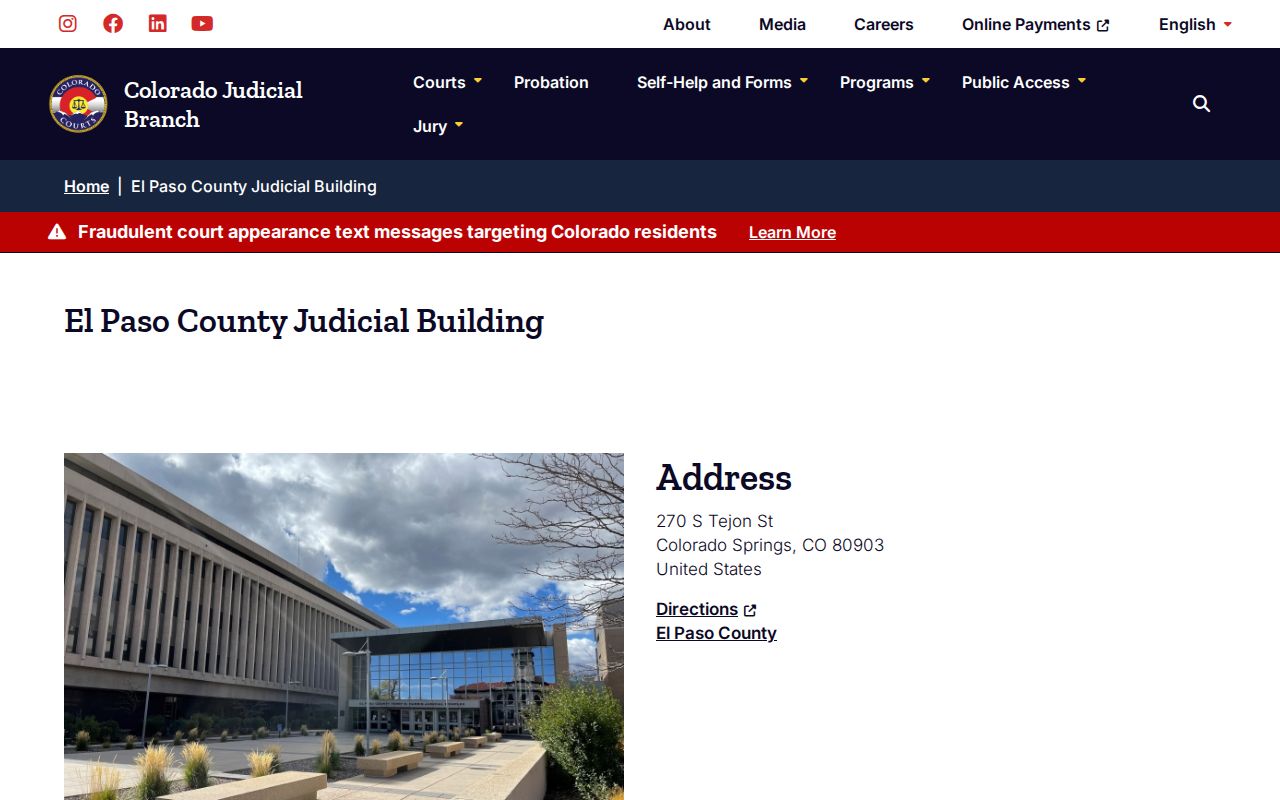
This contact block helps separate the clerk from the Sheriff records counter and jail.
Types of El Paso County Warrants
A warrant's label comes from the issuing court and the event behind it. Colorado sources favor three terms. The main ones are arrest warrant, bench warrant, and failure-to-appear warrant. Capias covers any order to bring a person before the court, but El Paso County agencies rarely lead with that word.
| Type | How It Arises | Issuer |
|---|---|---|
| Arrest warrant | Sworn facts support probable cause. | District, County, or municipal judge or magistrate. |
| Bench warrant | A person misses court or does not follow an order. | The judge in the case. |
| FTA warrant | A required appearance is missed. | The court holding the case. |
| Search warrant | Probable cause supports a defined search. | A judge or authorized magistrate. |
In El Paso County, a warrant is one order inside a case, so the evidence, the plea, and the final outcome remain separate questions.
El Paso County Docket Limits
The Colorado Judicial docket search finds an El Paso County setting by county and date. Its fields cover name, case number, hearing type, courtroom, time, location, and appearance method. A register of actions may carry labels like “Appearance on Arrest Warrant” or “Return of Service on Warrant.” Labels mark events, not status. Neither proves the warrant is active today. The docket page shows its search controls without any person's row.
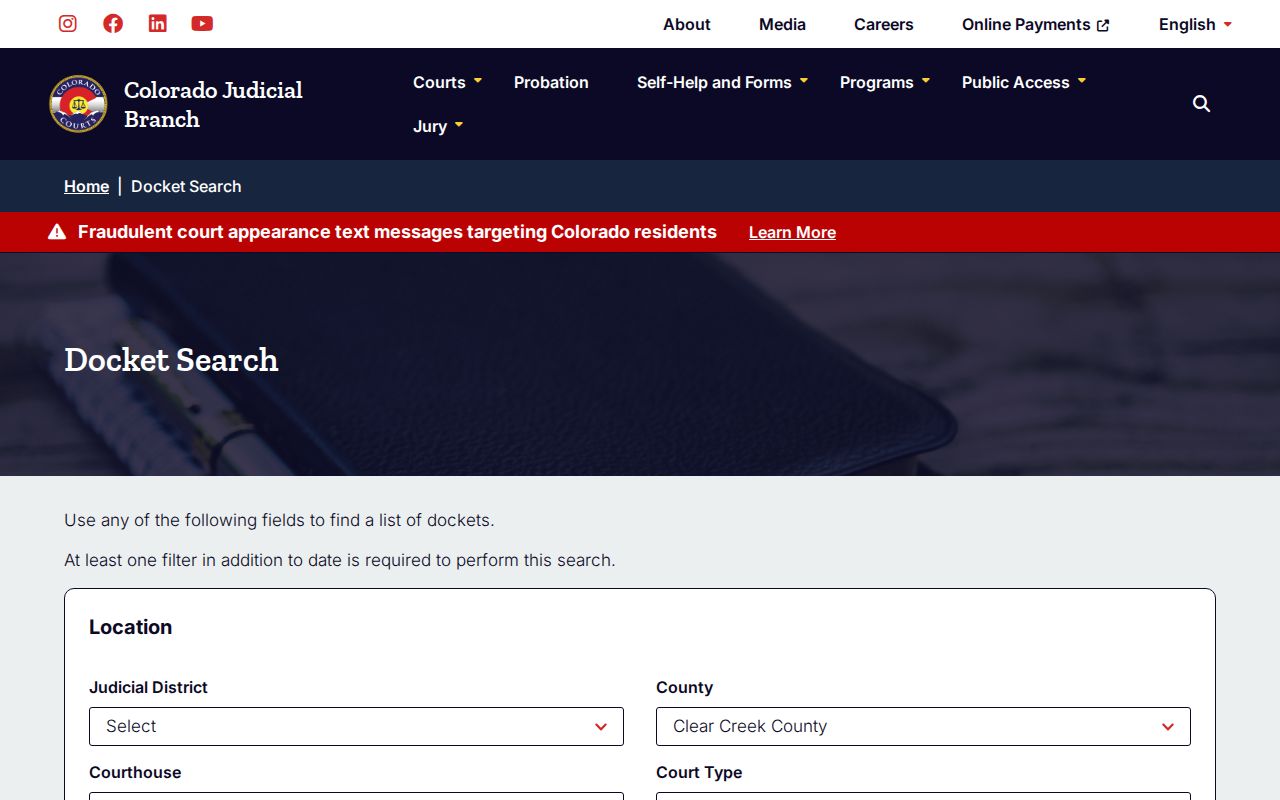
Treat the docket as the trail, then let the El Paso County clerk confirm whether the warrant itself still stands.
Key point: Colorado has no single public statewide warrant lookup. CCIC and NCIC are law-enforcement systems, not public portals.
What El Paso County Warrant Records Show
An official file gives a warrant its setting. Colorado case numbers open with the filing year and a case-type code. You might see 2026CR####, M for some misdemeanor matters, T for traffic, and JD for juvenile delinquency. In El Paso County, that code names the case stream. It says nothing about current warrant status.
| Case or warrant number | Links the event to a filing year and court file. |
|---|---|
| Type | May identify arrest, bench, FTA, or another order. |
| Charge | Shows the alleged offense when public. |
| Issuing court | Names the court controlling recall or the next appearance. |
| Bond | May show cash, surety, PR, or no-bond terms. |
| Service and status | Records issue, return, recall, quash, or service events. |
| Access note | Explains a seal, redaction, or restriction. |
A later court action can change the result, so always ask the El Paso County custodian for the current status.
Request El Paso County Warrant Records
When a docket lead runs dry, use the Judicial Record and Document Request Form. It accepts a county, a case number or party name, a filing year, and the document type. Ask for the register of actions. A complaint, disposition, ticket, or warrant-related event can be requested too. El Paso County court research questions go to 04ResearchRequest@judicial.state.co.us or Room S101. The official form shows its fields and fees.
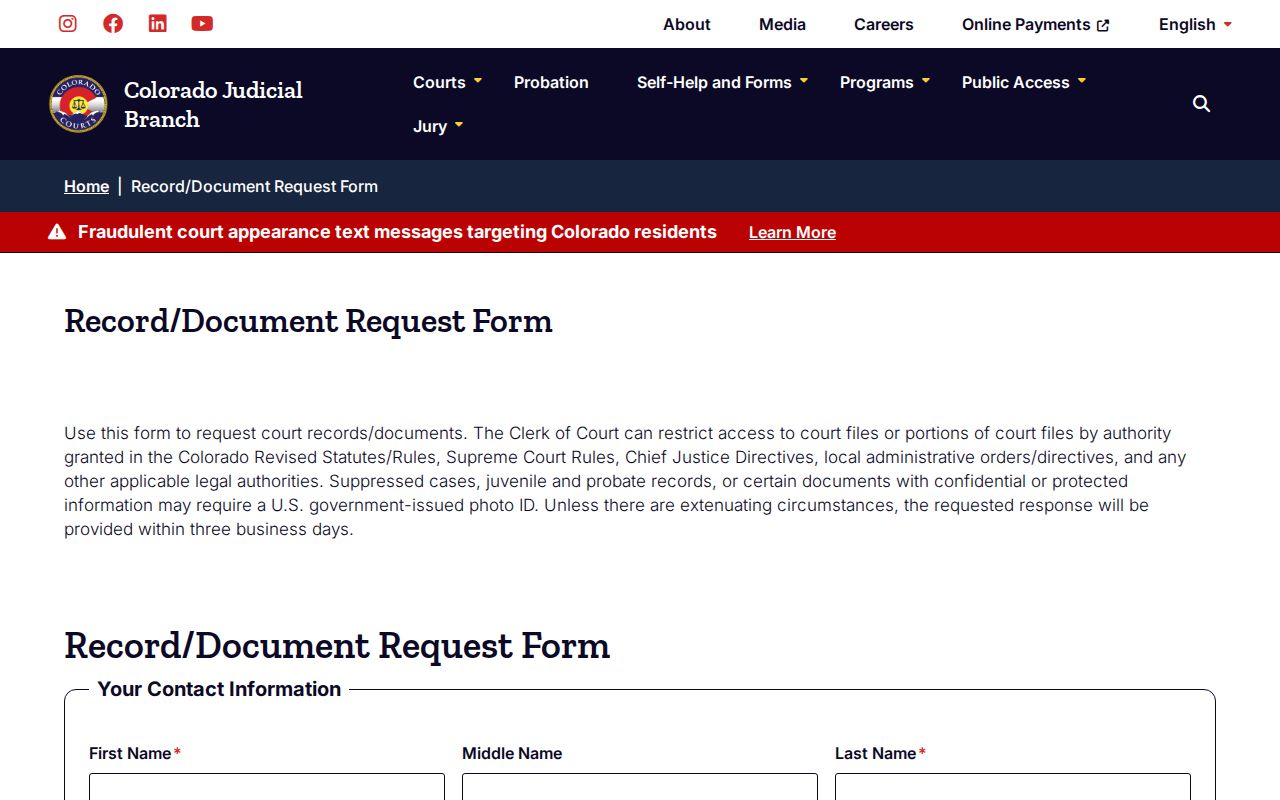
To separate people with similar names, give the case number, filing year, legal name, and date of birth. El Paso County Sheriff material takes a different route. Use the EPSO Records and Video Request page. Identify the case, the court or agency, the date, and the exact record wanted. Fees are posted there. Reports up to ten pages cost $8 to review and redact, then $0.25 per page beyond that. Under CCORA, research runs $32 per hour after the first free hour. Ask for an estimate first. The Sheriff's official page shows its forms and the current process.
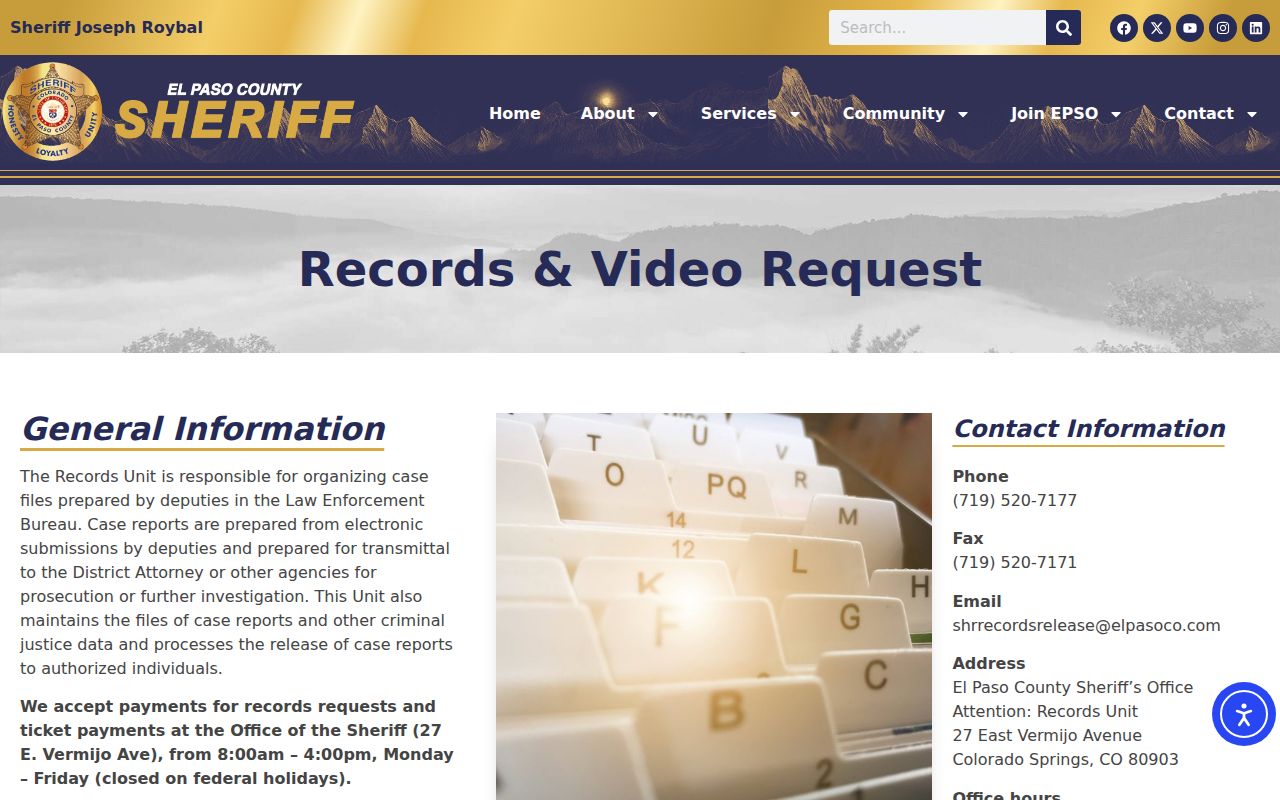
A records response documents releasable material, while the court confirms present warrant status.
Who Serves El Paso County Warrants
District Court handles El Paso County felonies. County Court takes misdemeanors, traffic, and petty offenses. Municipal judges hear city charter, ordinance, and local traffic cases. A judge or magistrate issues the process, and the Clerk of Court keeps the file. Service falls to the Sheriff, city police, a marshal, or another authorized agency. The local flow runs from complaint or summons to judicial decision, docket entry, a CCIC or city entry, service or a voluntary appearance, and then bond and advisement. After that comes a recall, quash, payment, or a new setting. An El Paso County agency that serves a warrant usually cannot recall it. Only the issuing court holds that power.
EPSO Court Warrant Information
270 S. Tejon Street
Colorado Springs, CO 80903
719-452-5000, option 6
El Paso County Court Records
Room S101, 270 S. Tejon Street
Colorado Springs, CO 80903
719-452-5490
El Paso County Warrant Workload
EPSO's 2021 report is history, not a live list. El Paso County numbers that year included 35,943 warrants received, 22,238 served, and 37,134 active on December 31, 2021. The active count split into 10,293 felony and 26,841 misdemeanor warrants. FTA matters received ran 5,505 felony and 20,812 misdemeanor.
Those dated totals sized El Paso County's court-warrant workload. They name no one and give no count of warrants open today.
Resolve an El Paso County Warrant
Start with the court that issued the El Paso County warrant. Ask what it allows: a new appearance date, cash or surety bond, personal-recognizance review, a planned surrender, or a motion to recall or quash. Recall means the court withdrew the warrant. Quash means it set the warrant aside. Neither step ends the charge by itself. Colorado Springs runs a detailed municipal route. Its Room 108 warrant desk says bail of $200 or less may earn a new date, while more than $200 requires cash or commercial surety, plus a $40 service fee. Other courts set their own process, and counsel can help plan a safe appearance.
Important: Confirm the warrant and speak with counsel before surrender; police contact may lead to arrest on an active order.
The bonding page covers El Paso County. Bonds may be posted around the clock, with cash, approved card, surety, PR, and no-bond situations explained.
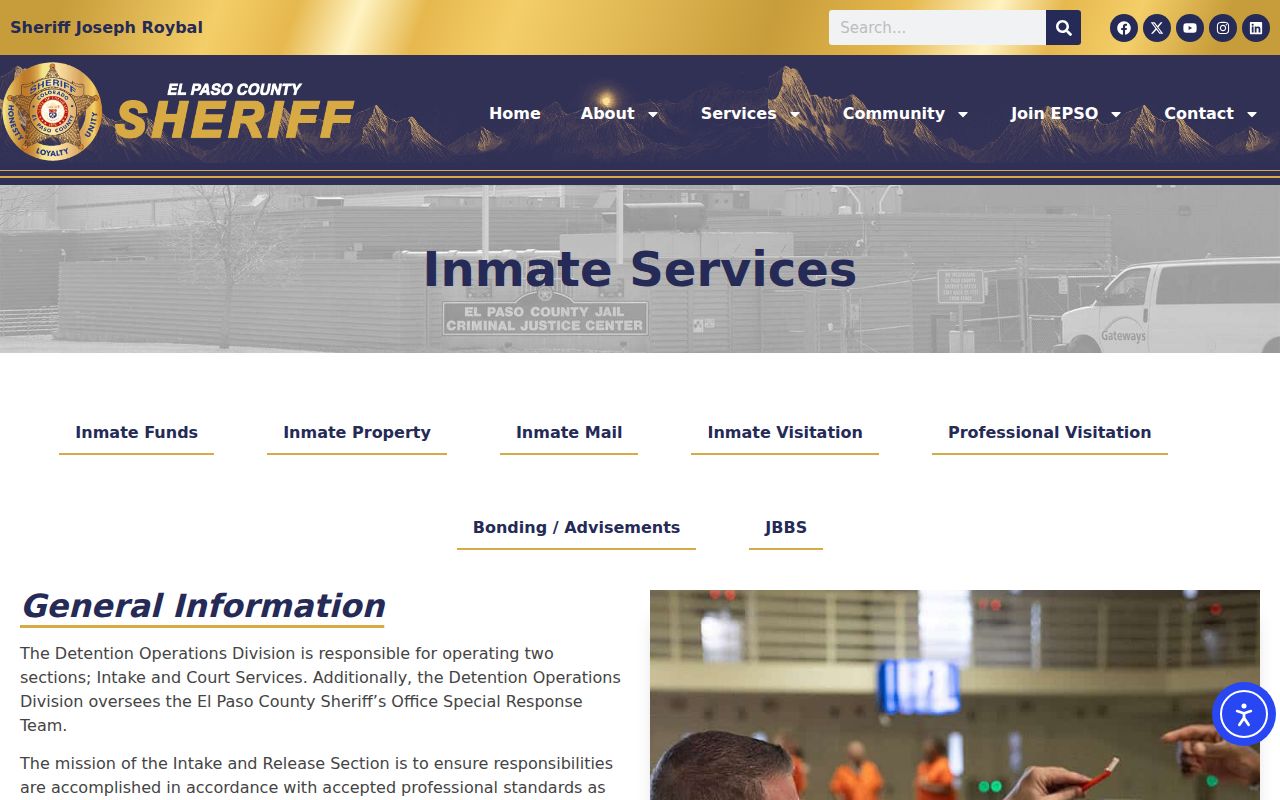
Bond addresses custody and a future appearance. It does not dispose of the case.
El Paso County Warrant Terms
Status words describe distinct court actions. Read them with an event date.
- Active
- Still recorded as enforceable.
- Bench warrant
- An order often caused by missed court or noncompliance.
- FTA
- Failure to appear at a required setting.
- Recalled
- Withdrawn by the issuing court.
- Quashed
- Set aside by the court, though the case may continue.
- Return of service
- A record of what happened when process was served.
Note: El Paso County sources chiefly use bench warrant, arrest warrant, and FTA warrant rather than capias pro fine.
Second Chances Warrant Clearance
The 4th Judicial District ran Second Chances Warrant Clearance and Community Resource Day on December 6, 2024. Its event notice lists eligible matters. Municipal, misdemeanor, traffic, selected lower-level felony, and some probation cases qualified. Stated serious categories stayed out. El Paso County courts, prosecutors, defenders, and partners helped eligible people address warrants, one dated example of several offices joining a planned resolution.
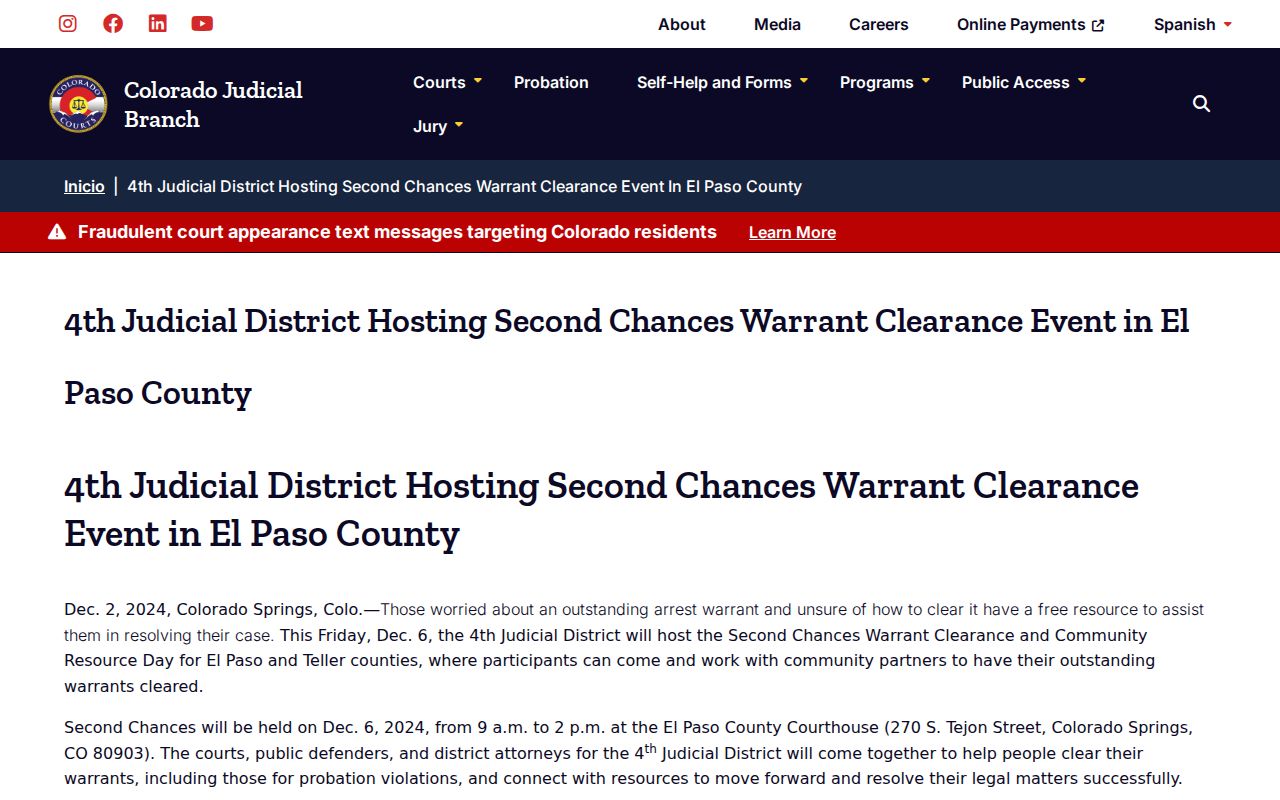
El Paso County ran its Second Chances warrant clearance as a one-day event, not an ongoing amnesty program, and no 2026 countywide calendar is posted.
Public El Paso County Warrant Access
El Paso County warrant records fall under the Colorado Criminal Justice Records Act, while broader county material may fall under the Colorado Open Records Act. Official actions must be kept for public reference. Still, a custodian can withhold or redact records when law, court order, investigation, or public interest requires it. Juvenile identifying material usually stays closed.
Key rules:
C.R.S. §§24-72-301 and 303 cover records of official actions.
C.R.S. §24-72-305 permits denial for legal and investigative limits.
C.R.S. §19-1-304 restricts juvenile records.
A sealed affidavit can stay closed even when another case event is public in El Paso County. Ask for the releasable register of actions.
Avoid El Paso County Warrant Scams
The Colorado Judicial Branch warned in May 2026 about fake traffic-court texts. The texts used generic court names, false case numbers, and payment links. Manitou Springs, in El Paso County, says the same about calls. Real law enforcement does not phone and demand instant money for a warrant or missed jury duty. Hang up. Dial an official number yourself. A true notice identifies the court, clerk or judge, courthouse, date, and time. Nobody legitimate wants gift cards or cryptocurrency to stop an arrest. Keep the message. Report it through an official channel. Safe verification starts with the court's own site or a paper summons already in hand. Compare the court, the case number, and the hearing date. Call the clerk at a number you found independently. End any call demanding payment at once. Colorado Springs Municipal Court, El Paso County Combined Courts, and each town court publish distinct contact routes. That separation makes a vague demand from an invented court easier to spot. Real warrant resolution creates a court record. A clerk may set a new appearance, explain bond, take an allowed payment, or direct an attorney filing. Ask for a receipt or written notice. Keep it with the case papers. Confirm the next date. A private payment demand with no matching court file does not clear an El Paso County warrant.
Warrant Records by El Paso County City
City warrants stay with each El Paso County municipal court. Colorado Springs keeps a warrant counter. Fountain has a citation portal, while Monument, Manitou Springs, and Palmer Lake rely chiefly on clerks. A city police ticket may still name Combined Courts, so read its address.
Colorado Springs
Fountain
Monument
Manitou Springs
Palmer Lake
These local routes supplement, but do not replace, the state-court check.